

One-way grille
Classification :
PRODUCT DETAILS
Specifications
Plastic geogrid (polypropylene/polyethylene)
Unidirectional tensile type (TGDG series): tensile strength 100-200MPa, high longitudinal tensile modulus, suitable for roadbed reinforcement and soft soil treatment.
Bidirectional tensile type: The grid size is commonly 25×25mm to 50×50mm, width is 2-6m, and the strengths of the horizontal and vertical directions are balanced.
Steel-plastic composite geogrid
The grid size is 30×30mm, the tensile strength is ≥180kN/m (such as GDG180 model), and it has strong corrosion resistance and is suitable for high load scenarios.
Fiberglass geogrid
Double-human double-weft type: mesh 25.4×25.4mm or 12.7×12.7mm, width 2-6m, tensile strength 30-100kN.
Three-mechanical and three-weft type: mesh hole 24.5×24.5mm, tension up to 100kN, suitable for special projects such as bridges and tunnels.
Polyester Warp Knitted Polyester Geogrid
High strength and low creep characteristics, suitable for long-term load bearing scenarios (such as highway subgrades).
Detailed explanation of key parameters
Physical Specifications
Mesh Size:
Small mesh type: 12.7×12.7mm (glass fiber type), used for high-density reinforcement.
Conventional type: 25×25mm to 50×50mm, suitable for most roadbed projects.
Width: 1-6m, can be customized to reduce joints and improve construction efficiency.
Mechanical Properties
Tension Strength:
Plastic one-way grille (such as TGDG200): ≥200MPa.
Glass fiber double-weather double-weather type: 30-100kN, three-weather three-weather type ≥100kN.
Steel-plastic grille: bidirectional ≥180kN/m.
Creep performance: Elongation ≤10% (plastics) to lower (glass fiber).
Process parameters
Production line index: Extruder specification Ø180/33, production speed 2-10m/min, production capacity up to 1000㎡/h.
Welding Strength: Tensile strength of plastic grating welding joints ≥160N/cm (national standard).
Application areas
Transportation infrastructure field
Highway and Railway Engineering
It is used for roadbed reinforcement, which increases the overall bearing capacity by dispersing loads and reduces settlement risks (such as plastic geogrids used for soft soil roadbed reinforcement).
To prevent and control road reflective cracks, glass fiber geogrids are used to suppress uneven settlement at the junction of new and old road surfaces.
The railway subgrade is enhanced to avoid premature cracking and improve stability (such as bidirectional grilles to reduce bilge damage).
Airport and Pier Project
Enhance the foundation of the airport runway, improve load-bearing capacity and crack resistance, and adapt to high-strength dynamic loads.
The dock cargo yard foundation is reinforced and high-strength grilles are used to deal with heavy machinery and cargo pressures.
Slope Protection and Tunnel Engineering
Steep slope protection (such as railway slopes) reduce displacement through modular laying, and combine with anchors to enhance stability.
Tunnel anchor support and mine tunnel reinforcement improve construction safety.
Water Conservancy Engineering Field
River management and dam protection
The river bank protection structure uses steel and plastic grilles to fill stone, which weakens the water flow erosion force by 45%.
During embankment reinforcement, a geomembrane is used to build an anti-seepage system to reduce the risk of leakage.
Drainage and Soil Conservation
Accelerate the drainage and consolidation of soft soil roadbeds and improve the bearing capacity of the foundation.
Intercept silt and allow permeability to reduce soil erosion.
Field of ecological restoration
Mine reclamation and desertification control
The cavity structure stores nutrients in water and soil, promotes vegetation recovery, and shortens the ecological restoration cycle.
Fix sand dunes in desert areas to reduce the impact of wind erosion.
Slope greening and cityscape
After filling the planting soil, sow grass seeds to form an ecological slope protection layer (such as municipal green belt).
Urban green spaces have enhanced water permeability, reducing the probability of waterlogging.
Urban construction field
Municipal Engineering
Reinforce soft foundations of buildings (such as parking lots, retaining walls), simplify construction processes and reduce construction costs.
Landfills are isolated from polluted soil and prevent the spread of harmful substances.
Pave crack resistance optimization
When the old cement pavement is renovated into composite pavement, the fiberglass grating suppresses the expansion of reflective cracks.
Semi-rigid base layer reinforcement to prevent the transmission of base layer cracks to the asphalt surface layer.
Environmental governance field
Pollution isolation and ecological barrier
Cover the polluted areas to isolate heavy metals or chemical pollutants and protect groundwater sources.
In the ash dam project of the power plant, structural stability is enhanced and environmental risks are reduced.
Construction process
Preparation before construction
Site cleaning and leveling
Remove debris (gravel, tree roots, etc.) in the construction area to ensure that the base is flat and dense, the compaction degree meets the design requirements, and the surface flatness error is ≤15mm.
Refilling or drying the weak foundation, and laying a sand and gravel cushion (thickness 20-30cm) if necessary to enhance drainage and consolidation.
Materials and Equipment Inspection
Verify the geogrid material certificate and mechanical properties (such as tensile strength, elongation, etc.) to ensure compliance with design parameters.
Prepare fixing materials (U-shaped nails, hook-shaped rivet piles), compaction machinery and testing tools.
Base processing and positioning
Roadbed base rolling
Roll the lower layer to compactness ≥ design requirements (such as compaction ≥95%), and excavate steps at the filling and excavation junction (width ≥175cm, slope inverted 4%).
Spray adhesive layer of asphalt (dose 0.5-1.2kg/m²) or lay a sand cushion (thickness 3-5cm) to enhance the bonding force between the grille and the substrate.
Measurement stake
Determine the laying range and the main force direction according to the design drawings, lay the full width at the horizontal filling and excavation junction, and extend the longitudinally to the excavation roadbed ≤5m.
Geogrid laying and fixing
Laying direction and tensioning
Unfold the grille along the main force direction (perpendicular to the line or slope) to keep it flat and without wrinkles. Construction can reduce shrinkage and deformation during high temperature periods.
After laying, it is immediately stretched to a tight state, with the overlap width ≥20cm in longitudinal direction and ≥15cm in transverse direction, and the overlapping points are fixed with tie wires or U-shaped nails.
Anchor and Fixation
The starting end is anchored with galvanized U-shaped nails or hook-shaped rivet piles (the spacing is ≤1.0m, and the anchoring depth is ≥60cm).
The top and foot of the slope need to be strengthened, and the steep slope section (slope > 60°) is fixed by anchor rods (length ≥ 2 times the height of the grid chamber + 30cm).
Filling and compacting process
Layered filler control
Fill symmetrically in the order of "first both sides and then middle", with the filler particle size ≤15cm and the discharge height ≤1m to avoid direct impact on the grille.
The thickness of each layer is ≤30cm. After initial filling, it is manually leveled to ensure that the grille does not deform.
Rinding Process
Crushing sequence: 2 static pressure (speed ≤15km/h) → vibration compaction (speed 2-2.5km/h), transverse staggered wheels 0.4-0.5m, compaction degree ≥ design requirements.
It is prohibited to directly contact the exposed grille by rolling machinery, and vehicles are strictly prohibited from passing through when the uncovered layer is constructed.
Quality acceptance and protection
Quality Test
Check the tension, overlap width and anchoring strength of the grille. The damaged areas need to be repaired or replaced.
Check the compactness of the packing and the flatness of the slope (Error ≤15mm), and enter the next process after passing the acceptance.
Drainage and Ecological Protection
Set up longitudinal drainage ditch (4m spacing) and communicate with the shoulder drainage system to prevent erosion.
Cover the planting soil and sow grass seeds, lay non-woven fabrics on the slope to prevent erosion, and remove the vegetation after survival.
Things to note
The construction avoids rainy days. The exposure time of the exposed grille is ≤48 hours, and the asphalt adhesive layer needs to be sprayed evenly.
The filler grading needs to be stable (gravel and sandy soil are preferred), and the layered compaction thickness is 20-30cm.
Through standardized process control, the reinforcement effect and durability of geogrids in roadbed reinforcement, slope protection and other projects can be ensured.
PACKING AND DELIVERY
At present, our products are exported to Southeast Asia, Africa, the Middle East, South America and other 50 countries and regions, looking forward to cooperating with you!
CONSTRUCTION CASES
Construction Cases
Construction Cases
Construction Cases
Construction Cases
Construction Cases
Construction Cases
FACTORY WORKSHOP
Geo-membrane blown film equipment
Geotextile Equipment
Geotextile Equipment
Quality Inspection
Geotextile Equipment
Workshop Equipment
Geo-membrane blown film equipment
Geo-membrane blown film equipment
FAQ
Q: How is the product packaged?
Q: Is there quality inspection before loading?
Q: What are the loading ports?
Q:Can you deliver the goods on time?
Q: Can we take some samples? Any fees?
How can we guarantee quality?
RELATED PRODUCTS
GET A FREE QUOTE
CONTACT US
Longji Science and Technology City, High-tech Zone, Tai'an City, Shandong Province
GET A FREE QUOTE
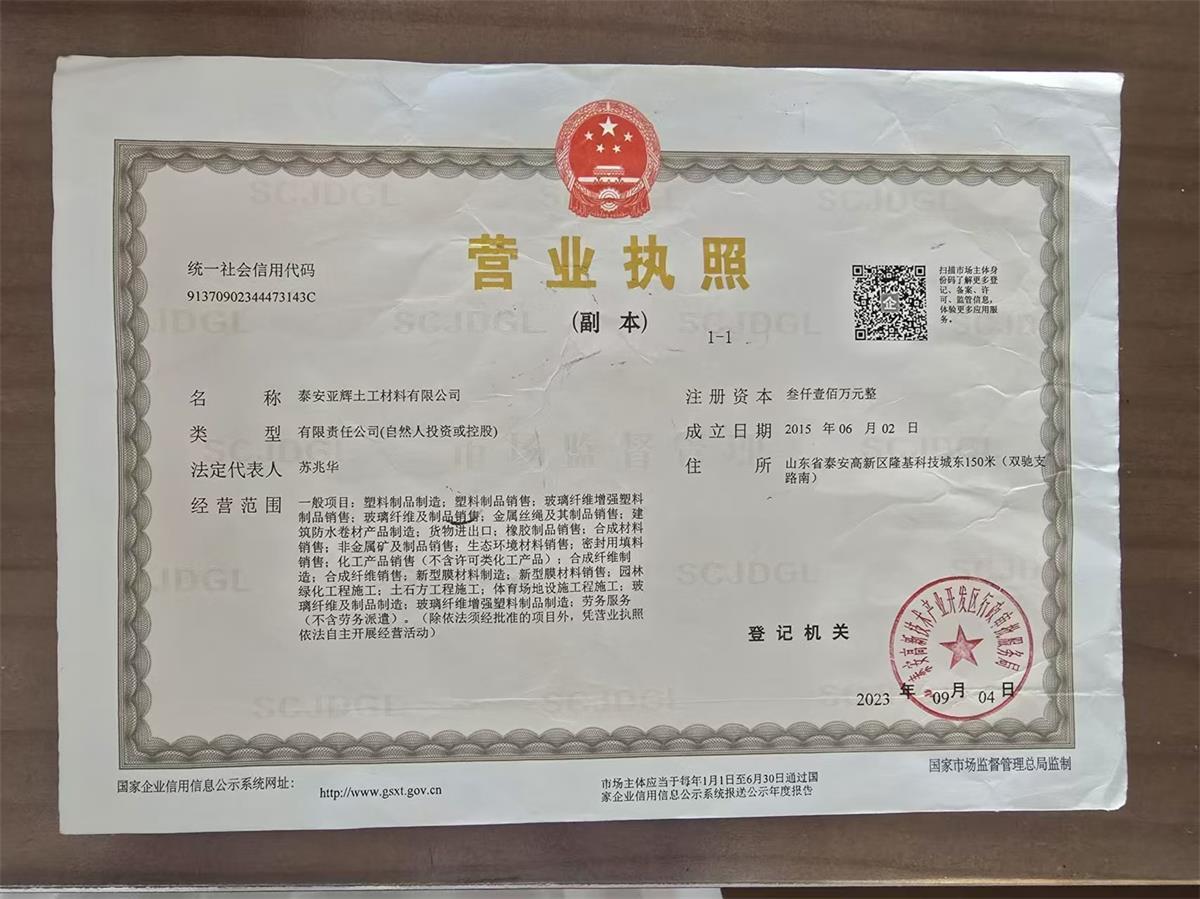
Copyright 2025 : Tai'an Yahui Geosynthetics Co., Ltd. Powered by:CEglobal SEO BUSINESS LICENSE